|
1,23,700 MBBS Seats in India (2025–26) |
808
Medical Colleges in India |
22.7 Lakh
NEET UG 2025 Registrations |
18.61% FMGE June 2025 Pass Rate |
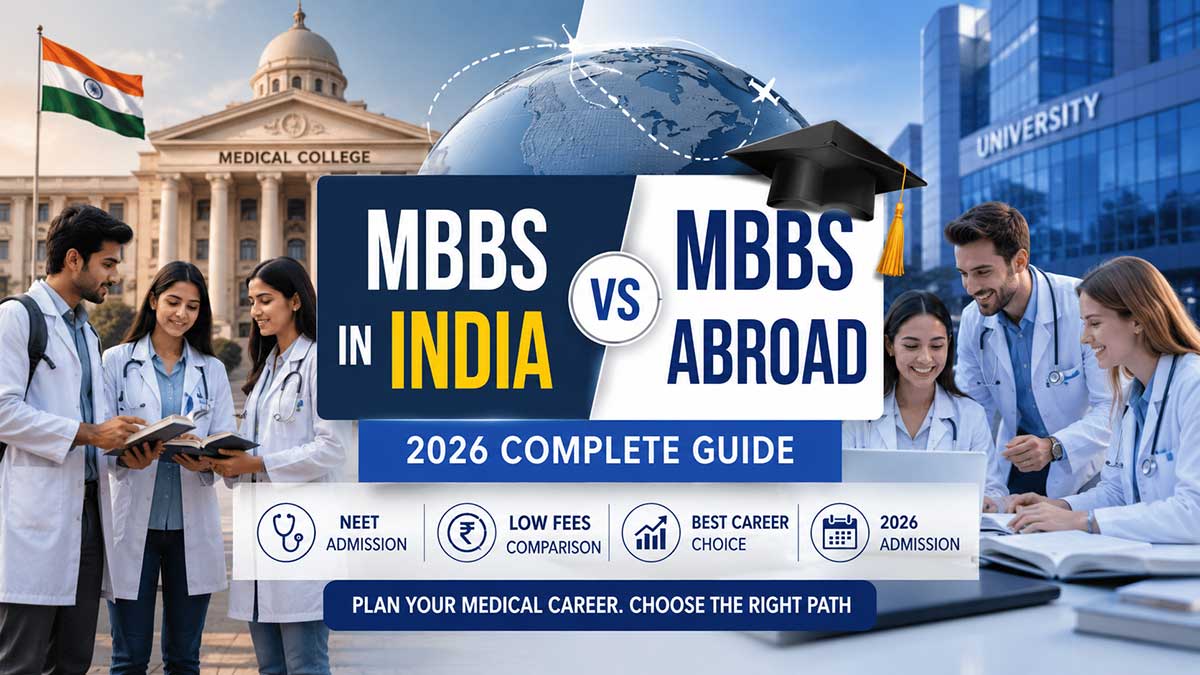
MBBS in India 2026: Government Seats, Fees, Top Colleges & Abroad Comparison
Every year, the medical admission story in India starts with the same reality. Too many students want MBBS seats, and too few seats are available. In 2025, more than 22.7 lakh students registered for NEET UG and around 20.8 lakh appeared for it. In comparison, India had just over 1,23,700 MBBS seats in the 2025–2026 cycle across 808 medical colleges. That gap is one of the biggest reasons why the question of MBBS in India vs abroad 2026 matters so much.
The pressure becomes real after results. A government MBBS seat in India is still the best value option — lowest cost, strongest clinical training, and the simplest path to Indian medical practice. But competition is intense. Private and deemed colleges can still be very expensive, even after the NMC clarified in April 2026 that MBBS fees should be charged only for the 4.5-year academic period, not the internship year.
That is why many families now look at studying MBBS abroad as a practical option, not just a backup dream. Foreign medical education may offer lower tuition and easier admission. But it comes with real risk: FMGE is still active in 2026, and the June 2025 pass rate was 18.61 percent. No student should choose abroad only because an agent’s brochure made it sound easy.
This guide explains the full picture — cost, licensing, recognition, clinical exposure, and risk. It starts with what MBBS in India offers, then compares abroad options honestly and factually.
Why Choose MBBS in India in 2026?
1. No FMGE. No Licensing Barrier.
This is still India’s biggest strength. A student who completes MBBS from a recognized Indian college follows the domestic path to registration after the required internship process under Indian rules. There is no separate foreign graduate screening barrier after completing the degree in India.
For students who study abroad, that extra hurdle is real. FMGE is still being held in 2026. In the June 2025 session, the pass rate was 18.61 percent. That means the exam is not a small formality. It is a serious filter. For some students, clearing that stage can delay the start of practice by a year or more.
2. The NExT Transition — What Students Should Know
NExT (National Exit Test) is already part of the regulatory discussion. The NMC has notified the National Exit Test Regulations, 2023. At the same time, FMGE is still being conducted in 2026 by NBEMS.
The practical approach is simple: do not assume FMGE has already gone away. Do not assume NExT will instantly replace everything for your batch. Plan using what is active today and keep watching official NMC notices.
3. Cultural Familiarity and Mental Well-Being
This is a very real point that many families overlook. Moving to another country at 18 or 19 is not easy. Food, weather, language, loneliness, and distance from family can affect academic focus more than students expect.
Studying in India reduces many of those stresses. It also keeps the student close to Indian patient communication, Indian hospital systems, and Indian exam priorities. The adjustment load is usually much lower.
4. Post-MBBS Ecosystem for NEET PG
If the long-term goal is NEET PG and a career in India, the ecosystem inside India is stronger. Coaching access, peer groups, internship relevance, and senior guidance all fit better into the Indian postgraduate path.
Students who return from abroad can still do very well. But many of them first have to clear the licensing hurdle and then step into the Indian PG race. That extra transition should be considered early — not ignored while choosing a college.
5. Government Seats Remain Unmatched in Value
As of the 2025–2026 cycle, official government-linked updates placed India at 808 medical colleges with 1,23,700 MBBS seats. Even with that growth, demand is still far higher than supply. But when a government seat is available, the value is hard to beat — lower cost, stronger clinical training, simpler licensing, and a smoother postgraduate path.
MBBS Seats in India 2026: Government, Private & Deemed
Understanding the seat landscape helps students set realistic targets before NEET results. India’s MBBS seats fall into three broad categories, each with very different fee structures and admission dynamics.
| College Type | Approx. Seats (2025–26) | Fee Range (Per Year) | Admission Route |
| Central Govt. (AIIMS, JIPMER, etc.) | ~4,500+ | ₹1,000 – ₹5,000 | NEET UG → MCC / AIIMS counselling |
| State Government Colleges | ~65,000+ | ₹10,000 – ₹1.5 lakh | NEET UG → State counselling |
| Private Medical Colleges | ~40,000+ | ₹5 lakh – ₹25 lakh+ | NEET UG → State / Management quota |
| Deemed Universities | ~14,000+ | ₹15 lakh – ₹27 lakh+ | NEET UG → Deemed counselling |
| Total India (approx.) | 1,23,700 | Varies widely | NEET UG mandatory for all |
MBBS in India Fees 2026: Government vs Private vs Abroad
The real fee decision starts when a student does not secure a government seat. Below is a factual comparison across all options. All abroad figures are converted at approximate May 2026 exchange rates and should be verified at the time of admission.
Comprehensive Fee Comparison Table
| College / Route | Country / Type | Annual Tuition (Approx.) | Total Course Cost (Approx.) | Duration |
| AIIMS New Delhi | India – Central Govt. | ₹1,000 – ₹5,000 | ₹5,000 – ₹28,000 (5.5 yrs) | 5.5 years |
| State Govt. Medical Colleges | India – State Govt. | ₹10,000 – ₹1.5 lakh | ₹55,000 – ₹8.25 lakh | 5.5 years |
| Mid-range Private College | India – Private | ₹5 lakh – ₹15 lakh | ₹25 lakh – ₹75 lakh | 5.5 years |
| Dr. D. Y. Patil, Pune (example) | India – Private/Deemed | ₹27 lakh (2025–26 listed) | ~₹1.21 crore (4.5 yr acad.) | 5.5 years |
| Tbilisi State Univ. (TSMU) | Georgia – Abroad | USD 8,000 (~₹6.7 lakh) | ~₹40–50 lakh total (6 yrs) | 6 years |
| Sechenov University | Russia – Abroad | ₹12.5 lakh equiv. (2024–25) | ~₹70–90 lakh total (6 yrs) | 6 years |
| Mid-range Russian University | Russia – Abroad | ₹3 – ₹7 lakh (varies) | ~₹20–50 lakh total (6 yrs) | 6 years |
| Philippines (varies widely) | Philippines – Abroad | Variable by program | Verify per university | ~5–6 years |
| Kazakhstan (mid-range) | Kazakhstan – Abroad | ₹2 – ₹5 lakh (varies) | ~₹14–35 lakh (6 yrs) | 6 years |
Top Indian Government Medical Colleges — Fees & 2025 Counselling Trends
The figures below are based on publicly available official and counselling-linked sources for 2025. Cutoffs change every round, by category, domicile, and quota. Always verify with official MCC and state counselling portals before making any payment.
| College | Location | Annual Fee (Approx.) | 2025 Gen. Closing Rank (AIQ) | Key Note |
| AIIMS New Delhi | New Delhi | ~₹1,390/year | ~47–48 | Highest-ranked; ultra-competitive |
| VMMC & Safdarjung Hospital | New Delhi | Govt. fee structure | ~132 | Strong central govt. college |
| MAMC (Maulana Azad) | New Delhi | Govt. fee structure | ~103 | Central govt.; Delhi domicile advantage |
| AIIMS Jodhpur | Rajasthan | ~₹1,390/year | Highly competitive | AIIMS network college |
| AIIMS Bhopal | Madhya Pradesh | ~₹1,390/year | Highly competitive | AIIMS network college |
| BHU (IMS) Varanasi | Uttar Pradesh | Central Univ. fee | Very competitive | Central university route |
| Grant Medical College | Mumbai | State govt. fee | Highly competitive | Top Maharashtra state college |
| JIPMER Puducherry | Puducherry | ~₹1,500/year | Very competitive | Central govt. institution |
| AFMC Pune | Maharashtra | Minimal (bond required) | Very competitive | Defence; bond-based service |
| Seth GS Medical College | Mumbai | State govt. fee | Competitive | KEM Hospital affiliation |
NEET 2026 Expected Cutoffs for MBBS in India
NEET cutoffs shift every year based on the total number of candidates, paper difficulty, and seat availability. The table below reflects 2025 counselling data as a reference baseline. Use these as directional guides — not guarantees.
| College | General (AIQ) | OBC (AIQ) | SC (AIQ) | ST (AIQ) | Remarks |
| AIIMS New Delhi | ~47–48 | ~200–250 | ~700–900 | ~1,200–1,800 | Ultra top tier |
| AIIMS Jodhpur / Bhopal | ~500–900 | ~1,500–2,500 | ~5,000–9,000 | ~12,000–20,000 | AIIMS network |
| JIPMER Puducherry | ~500–800 | ~2,000–3,500 | ~6,000–10,000 | ~15,000–25,000 | Central institution |
| VMMC New Delhi | ~132 | ~600–900 | ~2,500–4,000 | ~5,000–8,000 | Top Delhi govt. |
| MAMC New Delhi | ~103 | ~500–800 | ~2,000–3,500 | ~4,000–7,000 | Delhi domicile benefit |
| Grant Medical College | State quota applies | State quota applies | State quota | State quota | Maharashtra state counselling |
| Top State Govt. Colleges | Varies by state | Varies by state | Varies | Varies | Check state portal |
| Mid-range Private Colleges | ~80,000–3,00,000 | Lower | Lower | Lower | Management quota available |
Category definitions: AIQ = All India Quota (15% of government seats). State Quota (85%) is filled through state counselling. OBC/SC/ST/EWS categories have separate cutoffs. Domicile rules vary by state. Always check the MCC and respective state counselling authority for your category.
Education Quality and Clinical Exposure
Patient Volume: India’s Irreplaceable Advantage
India’s biggest advantage is patient volume. High patient load changes the entire learning experience. AIIMS New Delhi has publicly described average OPD footfall at around 10,000 patients a day in official material. In practical terms, this gives students in strong Indian teaching hospitals exposure to variety, urgency, and repetition that is hard to match elsewhere.
That matters because medicine is not learned only from books. It is learned through repeated patient contact, observation, communication, emergencies, and decision-making in real conditions. In that sense, top Indian government institutions remain exceptional training spaces.
Faculty Ratios and Infrastructure
The best Indian institutions combine patient load with strong departments, established referral systems, and active academic support. AIIMS, JIPMER, PGI-linked systems, and leading state medical colleges still carry weight because they are part of large working treatment systems — not just academic campuses.
Families should not assume every Indian college is equally strong. Private colleges and even some government-linked institutions can differ a lot in teaching quality and patient load. Due diligence matters in India too. The difference is that the best of the Indian system is genuinely exceptional.
Abroad: Structured but Lower Volume
Many foreign universities are classroom-disciplined and well structured, especially in the early years. The challenge often comes later with clinical volume. Hospital exposure may begin later, or real patient flow may be narrower than what Indian students see in busy teaching hospitals.
That does not mean foreign training is automatically poor. It means families need to judge the actual hospital environment — not just the campus image. A good foreign choice is possible, but only when both the academic setup and the clinical base are properly verified.
NMC’s 54-Month Rule — Critical for Students Going Abroad
This is one of the most important technical points for anyone planning MBBS abroad. The NMC framework requires at least 54 months of medical education followed by a minimum 12-month internship at the same foreign institution. The 2026 NMC advisory for Indian students going abroad repeats this warning very clearly.
Students should stay away from accelerated claims, split campus promises, or vague internship plans. A lower fee is not really a lower fee if the course later becomes unusable for licensure in India. Verify using: NMC Guidelines for Students Going Abroad
Not sure if your NEET rank qualifies for a government seat?
Talk to a counsellor before the counselling window closes. Get a free, no-obligation session.
→ Book Your Free NEET Counselling Session →
Why MBBS Abroad in 2026? (And Who Should Consider It)
Abroad options are not a backup for everyone — they are a genuinely better financial path for a specific type of student. Understanding who that is matters more than the marketing.
Lower Overall Cost — For the Right Comparison
The real comparison starts only when a student does not get a government seat and must choose between an expensive Indian private college and a foreign medical university. At the higher end in India, costs can rise very quickly. As referenced above, some premium deemed institutions list annual tuition above ₹27 lakh. Once hostel fees, deposits, and daily living expenses are added, the final spending can be very high — even after the NMC’s 4.5-year fee clarification.
Abroad, some destinations still look lighter on tuition. Georgia’s TSMU at USD 8,000 per year, or mid-range Russian universities, can represent a genuine financial saving over an expensive Indian private seat — when the total burden is honestly calculated.
Easier Admission — But Not Easier Outcomes
Admission abroad often feels simpler than the private seat race in India. For Indian students, NEET qualification is still the key requirement if they may want to return and practice in India later. After that, many foreign universities use a more direct document-based process.
But simple admission should never be confused with safe admission. The real question is whether the course structure, internship, teaching language, and licensing path match Indian rules. Easy entry means nothing if the degree later creates a problem in India.
Global Curriculum and International Exposure
Many foreign universities promote English medium teaching and organized classroom systems. Some students also look at abroad options because they are thinking ahead about exams like USMLE or other international pathways.
Even then, students need to stay careful. A university can look impressive in marketing material and still create problems later. The NMC has clearly stated that it does not endorse a general list of foreign medical institutions. So the real question is not whether a university is popular — it is whether the full course will satisfy the present Foreign Medical Graduate Licentiate rules.
Top Countries for MBBS Abroad — 2026 Comparison
Country-level data helps frame the decision, but students must verify university-by-university. A strong country-level FMGE result does not mean every institution inside that country performs equally well.
| Country | Typical Annual Tuition | Duration | FMGE Pass (2024) | Key Advantage | Key Caution |
| Russia | ₹3–12 lakh (varies) | 6 years | Varies widely | Large number of long-established universities | Hospital exposure and medium of instruction vary; verify per university |
| Georgia | USD 8,000 (~₹6.7L) at TSMU | 6 years | 35.65% (country-level, highest) | English medium; highest country-level FMGE rate | Country average ≠ every university performing equally well |
| Philippines | Variable by program | ~5–6 years | Variable | English-speaking environment | Route structure and duration can be more layered than students expect |
| Kazakhstan | ₹2–5 lakh (varies) | 6 years | Varies | Lower cost option | Medium of instruction, hospital exposure, and internship must be checked |
| Ukraine | Not primary concern now | 6 years | N/A | — | Security disruption still ongoing; not the preferred route for 2026 |
MBBS in India vs Abroad 2026: Side-by-Side Comparison
This is the table most families actually need. Compare all key factors in one place — honestly.
| Factor | MBBS India — Govt. | MBBS India — Private | MBBS Abroad |
| Total Cost | ₹5K – ₹8.25 lakh | ₹25 – ₹1.5 crore | ₹20 – ₹80 lakh (verify total) |
| Annual Tuition | ₹1K – ₹1.5 lakh | ₹5 – ₹27 lakh+ | ₹2 – ₹12 lakh (varies) |
| Duration | 5.5 years | 5.5 years | 6 years (most countries) |
| NEET Required? | Yes — mandatory | Yes — mandatory | Yes (for India return path) |
| Licensing After Degree | Direct Indian registration | Direct Indian registration | FMGE / NExT required |
| FMGE Risk | None | None | High — 81.4% failed in Jun 2025 |
| Clinical Patient Volume | Very High (AIIMS: ~10K OPD/day) | Variable by college | Usually lower; verify hospital |
| PG Ecosystem | Excellent | Good | Challenging (extra transition step) |
| Admission Difficulty | Very High | Moderate to High | Lower (document-based) |
| Language of Instruction | English | English | English or local language |
| NMC Recognition Risk | None | None | Moderate to High (verify rules) |
| Mental / Cultural Adjustment | Low | Low | High (new country at 18–19) |
Which Option Is Better for You? A Decision Framework
There is no single answer for everyone. The better choice depends on NEET rank, budget, career plans, and how much licensing risk a family is ready to accept.
| ✅ Choose MBBS in India If: | ✅ Consider MBBS Abroad If: |
| • Your NEET rank gives a real chance at a government seat or affordable govt.-linked option
• Long-term goal is NEET PG and a career in India • You want to avoid FMGE uncertainty entirely • You value stronger Indian clinical exposure and system continuity • Family support and a lower adjustment burden matter to you |
• Your NEET rank does not convert to a realistic Indian option within your budget • A foreign university is genuinely cheaper than a very high-fee Indian private college — after full cost calculation • You understand licensing risk is real and are ready to prepare for FMGE early • You are open to an international path, not only an India return path • You are ready to verify the university through current NMC rules — not agent claims |
The Financial Reality Check
This is the calculation that should guide the decision. Compare total tuition + hostel + travel + daily living + coaching cost + possible licensing delay + opportunity cost. Do not compare only the brochure tuition.
A foreign option that looks cheap at first can become costly if it brings delay and uncertainty. An Indian private seat that looks expensive may still make sense for a family that values certainty above everything else. A decision is financially smart only when it is honest about both money and risk.
When and How to Use Admission Consultants
This is where many families go wrong. Good admission consultants can reduce confusion. Weak ones can make it worse. The medical admission space is full of half-truths, repeated sales pitches, and vague promises.
What Good Admission Consultants Actually Do
The best consultants help families in four practical ways: they compare options honestly, explain counselling and paperwork, point out compliance risks, and help reduce avoidable errors.
A useful consultant should be able to explain: current NMC conditions, NEET eligibility, the 54-month study rule, same-institution internship requirement, document timelines, and the likely financial burden. If they cannot clearly explain the licensing path, they are not doing the job properly.
When to Engage Them
The best time is after NEET results and before the family starts acting on random advice. That is the window when India, private, deemed, and abroad choices can still be compared calmly.
Red Flags to Watch For
- Promising guaranteed admission without respecting NEET rules
- Describing foreign colleges as “NMC-approved universities” as a blanket claim
- Unable to explain the 54-month study rule and same-institution internship requirement
- Hiding fee layers, hostel charges, or service charges
- Unable to show proper documentation or realistic past student outcomes
- Pressuring a decision before NEET counselling rounds are complete
Conclusion
The MBBS in India vs abroad 2026 decision is not about glamour or brand name. It is about fit — budget, rank, risk, and the kind of future the student wants.
If a government seat in India is available, that remains the strongest value option. The cost is lower. The licensing path is safer. The clinical exposure is stronger. The postgraduate ecosystem is more supportive.
If a government seat is not available and an expensive Indian private seat is not financially practical, abroad can still be a valid route. But it must be treated as a regulated decision — not a sales decision. Verify course duration, internship design, teaching language, and licensure suitability before paying anything.
Understand the full MBBS in India fees and colleges picture before ruling India out. Compare abroad on total cost and total risk — not only on how easy admission looks. Use admission consultants only when they bring transparency and structure, not just confidence and commission.
The right choice is the one made with clear numbers, verified rules, and a realistic long-term goal. That is what makes this decision safer and smarter.
References & Official Sources
All statistics and regulatory information in this article are sourced from official portals. Click each link to verify.
- National Medical Commission — For Students Wishing to Study Abroad
- NMC — Foreign Medical Graduate Licentiate (FMGL) Regulations, 2021
- NMC — National Exit Test (NExT) Regulations, 2023
- NMC — Clarification on Fee Chargeable for MBBS Course Duration (April 2026)
- NBEMS — FMGE Notices and Result Pages
- NTA — NEET UG 2025 Official Portal
- PIB / Ministry of Health & Family Welfare — Medical Education Capacity Updates
- MCC — Medical Counselling Committee Official Portal
- AIIMS New Delhi — Official Pages and Patient Services Reports
- Tbilisi State Medical University — International Students Prospectus
- Sechenov University — International Admissions (2024–25)
Frequently Asked Questions — MBBS in India & Abroad 2026
As of the 2025–2026 cycle, India has 1,23,700 MBBS seats across 808 medical colleges, per official government-linked updates from the Ministry of Health and PIB.
The FMGE (Foreign Medical Graduate Examination) pass rate in June 2025 was 18.61 percent, as conducted and published by NBEMS.
Yes. For Indian students who wish to return and practise medicine in India, qualifying NEET UG is a mandatory requirement under the current NMC framework.
As per the NMC framework, a minimum of 54 months of medical education followed by a minimum 12-month internship at the same foreign institution is required. Shortcut or split-campus programs that do not meet this rule create serious licensure risk.
No. NEET UG is mandatory for admission to all MBBS courses in India — government, private, and deemed universities alike. There is no valid alternative pathway in 2026.
NExT (National Exit Test) has been notified under NMC’s National Exit Test Regulations 2023. As of 2026, FMGE is still being conducted by NBEMS. Students should follow official NMC notices for batch-specific transition updates and not assume FMGE has been discontinued.
There are 23 AIIMS (All India Institute of Medical Sciences) institutions across India as of 2026, including AIIMS New Delhi and 22 newer AIIMS established under the Pradhan Mantri Swasthya Suraksha Yojana.
MBBS from Russia can be valid in India if the course complies with current NMC rules — including the 54-month study requirement, same-institution internship, and FMGE clearance. Compliance must be verified per university, not assumed based on the country name or agent claims.
Private MBBS fees in India vary very widely. High-fee deemed and private institutions can charge ₹15–₹27 lakh or more per year. The NMC has clarified that fees can only be charged for the 4.5-year academic period. However, hostel, deposits, and living costs still add considerably to the total burden.
Maharashtra, Tamil Nadu, Karnataka, and Uttar Pradesh are consistently among the states with the highest number of MBBS seats. Exact figures vary by academic cycle. Refer to official MCC and Ayush counselling portal data for the current year.