The End of the Unstructured Medical Path
For years, pursuing a medical career simply acted as a highly predictable routine. You would pass a basic exam, and you would join a general degree. But technically, that static dynamic is no more. We have officially entered the era of specialized career planning, where knowing how to become a dermatologist requires intense focus. Students are now actively formulating their own academic hypotheses, clearing rigorous entrance exams, and executing complex educational processes entirely on their own. The medical student is no longer just a passive learner. They are rapidly becoming the lead architect of their future.
How Aspirants Run Their Academic Journeys
The latest educational breakthroughs prove that medical training now scales exactly like elite science. Modern aspirants do not require step-by-step parental handholding or rigid templates. Instead, they use multi-phase frameworks to divide and conquer massive syllabi autonomously.
| NEET PG Dermatology (2026 Data) | Seat Allocation & Competition |
|---|---|
| Total PG Seats in India | 506 (Govt, DNB, Deemed) |
| Top State (Karnataka) | 81 available seats |
| Top State (Maharashtra) | 70 available seats |
| Best Rank Filled (General) | Rank #20 |
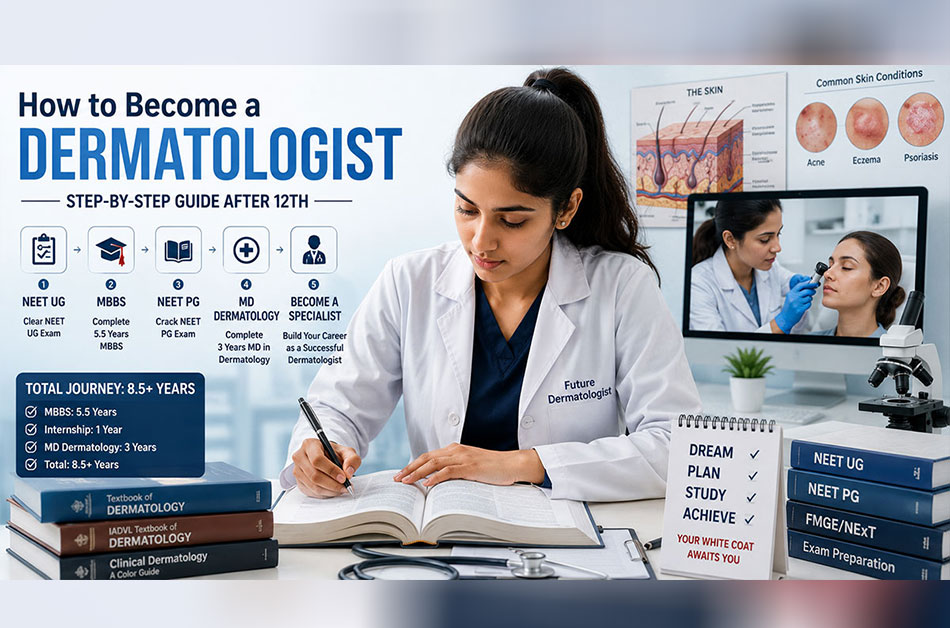
Here are the exact steps to become a dermatologist today:
- The Foundation: A core student evaluates a broad pre-med subject and independently formulates a comprehensive study strategy.
- The Executor: The aspirant enrolls in medical school, explores different clinical paths, and systematically clears licensing exams without external intervention.
- The Synthesizer: Finally, the doctor compiles their clinical hours, analyzes the resulting residency data, and drafts a complete specialization portfolio. Remarkably, some dedicated students have already successfully passed board peer review.
Mastering the Science of Continuous Learning
Linear study workflows are completely outdated. The true secret behind choosing a dermatologist course after 12th is the profound ability to run multiple academic tests simultaneously. To achieve this massive scale, advanced students rely heavily on disciplined study loops.
Instead of waiting for one single exam result to finish, these aspirants use complex academic methodologies. This means they actively explore, refine, tune, and discard multiple study hypotheses in parallel. If a specific revision tactic fails, the student instantly pivots. They learn from the mistake and immediately launch a new study technique. Consequently, these academic experiment loops perfectly mirror the absolute best agile learning pipelines. But crucially, they operate at a speed and scale no casual student could ever match. No unguided study group can realistically keep up with that output.
What This Means for Future Doctors
This radical shift extends far beyond academic high schools. It is already reshaping how real students make educational decisions. For science majors, competitive exam takers, and medical hopefuls, understanding how to become a dermatologist is about to completely redefine career intelligence.
- Exam Preparation: Students can actively synthesize thousands of past question papers. They can test multiple exam angles in parallel. They can then deliver a finalized study strategy while you sleep.
- Degree Selection: Undergraduates can aggressively use these insights to test their dermatology course after 12th grade continuously. They can run mock exams at scale. They can also discover knowledge gaps in real time, before examiners ever see them.
- Residency Strategy: Medical graduates can seamlessly deploy mentors to analyze placement trends in depth. These applicants can automatically generate massive, data-backed application clusters. They turn raw clinical data into match-ready residency ideas.
Prepare for the New Standard of Education
The barrier to entry for world-class medical training has fundamentally evolved. Any student with access to the right resources can now run the steps to become a dermatologist that once required entire counseling departments. Candidates who still rely on outdated advisors to manually plan their path will fall behind. Those who only target basic degrees will also be severely outpaced. It is time to aggressively audit your current study workflows. Start integrating these specialized milestones into your daily preparation today. Embrace the immediate shift from general studies to full medical specialization, and let your academic discipline rapidly scale your future.
Disclaimer:
Educational pathways and entrance exam statistics change annually. The seat allocations and rank requirements mentioned are based on recent counseling estimates. Always verify current data with the National Medical Commission (NMC).
Frequently Asked Questions (FAQs)
The path is completely structured. You must clear NEET UG, complete a 5.5-year MBBS degree, crack the highly competitive NEET PG exam, and finish a 3-year MD in Dermatology, Venereology, and Leprosy.
There is no direct dermatology course immediately after 12th. You must first secure an MBBS degree. MBBS is the fundamental baseline before you can specialize.
It requires a minimum of 8.5 years of aggressive medical training. This includes 5.5 years of MBBS and 3 years of postgraduate residency. Linear shortcuts simply do not exist.