The End of the General Skincare Era
For years, treating skin conditions simply acted as a highly basic routine. You would see a rash, and you would apply a generic cream. However, that static dynamic is officially dead. We have officially entered the era of specialized skin science, where understanding the true dermatologist’s meaning is essential. They are now actively formulating their own treatment hypotheses, writing original prescriptions, and executing complex surgical processes entirely on their own. The skin doctor is no longer just a cosmetic sidekick. They are rapidly becoming the lead specialist in comprehensive healthcare.
How Skin Specialists Run Their Clinics
The latest breakthroughs prove that dermatology now scales exactly like internal medicine. Modern practitioners do not require step-by-step hospital handholding or rigid templates. Instead, they use multi-disciplinary frameworks to divide and conquer massive patient cases autonomously.
| Patient Demographics & Burden | Statistical Reality in India |
|---|---|
| Doctor-to-Patient Ratio | 1:130,000 (Dermatologist specific) |
| National Male Prevalence | 40.1% suffer from skin disorders |
| National Female Prevalence | 23.7% suffer from skin disorders |
| Childhood Prevalence (5-14 yrs) | Accounts for 66.8% to 69.4% of cases |
Here is exactly what a dermatologist does today:
- The Diagnostician: A core medical expert evaluates a broad symptom and independently formulates a comprehensive healing strategy.
- The Surgeon: The specialist performs precise procedures, explores different treatment paths, and systematically removes skin lesions without external intervention.
- The Synthesizer: Finally, the doctor compiles pathology findings, analyzes the resulting data, and drafts a complete care plan. Remarkably, some advanced treatments have already successfully passed rigorous medical peer review.
Mastering the Science of Continuous Care
Linear treatment workflows are completely outdated. The true secret behind a modern dermatologist’s job description is their profound ability to run multiple diagnostic tests simultaneously. To achieve this massive scale, advanced specialists rely heavily on data-driven clinical loops.
Instead of waiting for one single lab result to finish, these doctors use complex diagnostic methodologies. This means they actively explore, refine, tune, and discard multiple medical hypotheses in parallel. If a specific medication fails, the specialist instantly pivots. They learn from the reaction and immediately launch a new targeted therapy. Consequently, these clinical experiment loops perfectly mirror the absolute best agile healthcare pipelines. But crucially, they operate at a speed and scale no untrained practitioner could ever match. No general medical group can realistically keep up with that specialized output.
What This Means for Medical Students
This radical shift extends far beyond academic hospitals. It is already reshaping how real medical aspirants make decisions. For pre-med students, biology majors, and future surgeons, the dermatologist job description is about to completely redefine career intelligence.
- Clinical Practice: Specialists can actively synthesize thousands of patient cases. They can test multiple treatment angles in parallel. They can then deliver a finalized recovery strategy while you sleep.
- Cosmetic Procedures: Aesthetic teams can aggressively use these systems to test dermatological updates continuously. They can run laser ablations at scale. They can also discover skin anomalies in real time, before patients ever feel them.
- Pathology Research: Medical agencies can seamlessly deploy doctors to analyze disease trends in depth. These specialists can automatically generate massive, data-backed treatment clusters. They turn raw biopsy data into publish-ready clinical ideas.
Prepare for the New Standard of Medicine
The barrier to entry for world-class dermatology has fundamentally shifted. Any student with access to the right education can now run clinical loops that once required entire departments. Aspirants who still rely on general practice to manually treat patients will fall behind. Those who only look at basic symptom checkers will also be severely outpaced. It is time to aggressively audit your current career workflows. Start integrating these specialized ambitions into your daily studies today. Embrace the immediate shift from general medicine to full specialization, and let your medical expertise rapidly scale your career.
Disclaimer:
This content is for informational purposes only. It does not substitute professional medical advice. Medical data and patient burden statistics vary by region and are based on referenced sample studies.
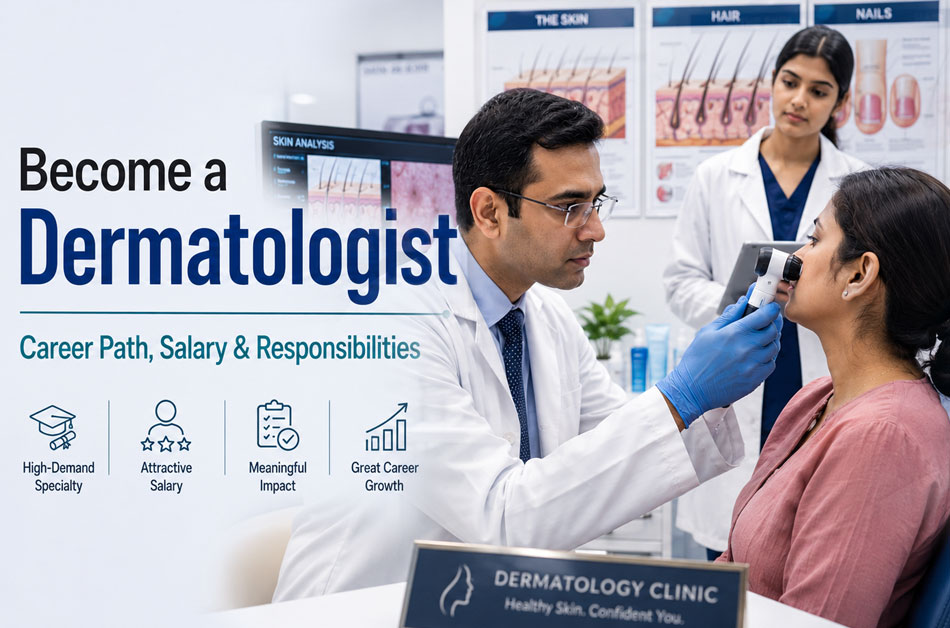
A dermatologist is a highly specialized medical doctor. They diagnose and treat conditions related to skin, hair, and nails. They are no longer just basic cosmetic advisors. They are the lead clinical surgeons handling complex pathology.
They run continuous diagnostic loops. They evaluate severe skin diseases, perform laser and surgical ablations, and synthesize biopsy data. They handle both medical emergencies and aesthetic procedures simultaneously.
Absolutely. They complete a full MBBS degree followed by a rigorous MD or DNB in Dermatology. The barrier to entry is extremely high.