Every counselling season, a specific kind of panic email lands in admission consultants’ inboxes. Usually from a parent in Dubai, or Chicago, or Singapore. The subject line is some version of “Our documents got rejected — what now?”
By then, it’s often too late to fix cleanly.
NRI Quota MBBS admission runs on paperwork that has almost zero tolerance for error. One missing affidavit, one uncle whose relationship isn’t recognised under Supreme Court guidelines, one embassy certificate signed by the wrong authority — any of it can knock an otherwise-qualified candidate straight out of contention. This guide walks through exactly what’s required for 2026: who counts as NRI-eligible, how sponsorship actually works, what MCC’s conversion process looks like this year, and which colleges are worth targeting.
What Changed Right Before This Guide Was Written
Worth flagging upfront, because it’s genuinely fresh: on 6th August 2026, MCC issued an urgent advisory specifically for OCI and NRI candidates in NEET UG 2026 counselling. The notice makes one thing unambiguous — document verification for NRI quota seats across Deemed Universities, Central Universities, and AIQ colleges must happen before online choice filling begins, not after. Miss that window, and you lose eligibility for NRI seat allocation in Round 1. No extensions, no exceptions mentioned.
That’s a shift worth internalising early. In earlier cycles, some candidates treated document verification as something to sort out during or after choice locking. That approach doesn’t survive this year’s advisory.
Who Actually Qualifies for NRI Quota
There are three main labels under this specific umbrella. People confuse them all the time. Here is the actual difference.
- Non-Resident Indians (NRI). They are still fully recognized Indian citizens. They simply reside overseas for a large portion of the year.
- Overseas Citizens of India (OCI). They actually hold a foreign passport and citizenship. But because they have Indian heritage, they carry a special OCI card for lifelong visa-free travel.
- Persons of Indian Origin (PIO). This specific category barely exists anymore. It was completely folded into the OCI program to avoid confusion. A few older legal certificates still use the name, but that is about it.
Here’s a distinction that trips people up constantly: OCI status and an NRI certificate are not interchangeable. An NRI certificate is typically issued to an Indian passport holder who lives overseas. OCI is a different legal status altogether, granted to foreign nationals of Indian descent. Counselling authorities apply separate guideline sets to each, so don’t assume one automatically covers the other.
Beyond direct NRI/OCI candidates, there’s a fourth and much larger group: NRI-sponsored candidates. These are Indian students, studying in India or abroad, whose MBBS fees are being funded by a close relative living overseas. This sponsorship route is where most of the document complexity actually lives.
The Sponsor Relationship Rules — Where Most Rejections Happen
This is, by a wide margin, the section families get wrong.
If you want to understand current NRI sponsorship rules, you have to look at the legal history. Everything points back to a landmark Supreme Court order from August 2017. The legal dispute was between Karnataka’s deemed universities and the Union of India. Even now in 2026, this specific decision matters immensely. Counselling boards still quote this exact judgment constantly. It acts as their ultimate rulebook whenever they closely examine your submitted sponsorship paperwork.
The core rule: the sponsor must be a first-degree or close blood relation to the candidate. Acceptable relationships generally include:
- Parents
- Siblings
- Grandparents
- Uncles and aunts (blood relation, not by marriage, in most jurisdictions)
Sponsorship by friends, distant relatives, family friends, or any non-blood acquaintance gets rejected during scrutiny — reliably, and without much room for appeal. Some state authorities apply a stricter reading than others; a few permit slightly broader relationships, others insist on direct blood ties only. Don’t assume your state follows the most lenient interpretation without checking that state’s specific bulletin.
Document Checklist
Here’s what candidates and sponsors typically need to assemble, based on current MCC and state counselling requirements:
Sponsor’s documents:
- Valid passport with visa or residency proof of the country of residence
- NRI status certificate or Embassy/Consulate certificate from the Indian Embassy in the country of residence
- Notarised Sponsorship Affidavit — a legal declaration that the sponsor will bear the full financial cost of the candidate’s MBBS programme
- Relationship Affidavit — official birth certificates, government-issued family register excerpts, or a notarised family tree establishing the direct blood relationship
- Bank statements or income proof, in some states, to establish financial capacity
Candidate’s documents:
- NEET UG 2026 Admit Card and Scorecard
- Class 10 Certificate (as date-of-birth proof)
- Class 12 Mark Sheet and Certificate
- Passport and/or Aadhaar
- Passport-size photographs in the prescribed format
All of it needs notarisation and, in most cases, authentication through the relevant consulate. Documents submitted in a format the counselling authority doesn’t recognise — or missing even one notarisation stamp — routinely get bounced back during scrutiny. Given how tight some conversion windows run (often just two to three days), a rejected document usually can’t be fixed and resubmitted in time.
How the MCC Conversion Process Actually Works
Here’s something a lot of families don’t realise until it’s almost too late: you don’t register as NRI when you first sign up for NEET.
Every candidate registers under the general Indian category by default at the NTA stage. NRI status isn’t something you select there. It gets applied later, through a dedicated conversion window that MCC opens before Round 1 or Round 2 of counselling — never during Mop-Up or Stray Vacancy rounds. That window tends to be short. Two to three days, based on recent cycles, and documents must usually be emailed in a single submission, in a prescribed format, within a defined time slot. Miss the slot by even an hour, and the submission isn’t considered.
The broad sequence looks like this:
- Register for NEET UG 2026 counselling on the MCC portal under the general category
- Pay the counselling fee and required security deposit — commonly around ₹2,00,000 for deemed university seats
- Watch for MCC’s dedicated notice announcing the Indian-to-NRI conversion window
- Submit all sponsor and candidate documents via the specified email address, strictly within the stated window
- Wait for MCC’s review — approved candidates get added to a published NRI list
- Once approved, you compete only under NRI Quota for the remainder of that counselling cycle. There’s no switching back and forth between general and NRI category mid-process
If MCC rejects the conversion request over incomplete or invalid paperwork, the candidate’s category simply reverts to General. That’s not necessarily fatal — general category seats in deemed universities and management quota remain open — but it does mean losing access to the (often lower-cutoff) NRI seat pool for that round.
Fee Structures: What NRI Quota Actually Costs
This is where the trade-off becomes real. NRI quota seats generally come with lower academic competition, but noticeably higher fees.
| College Tier | Approx. Annual NRI Fee | Approx. Total Course Cost |
| Top-tier deemed universities (KMC Manipal, Sri Ramachandra Chennai) | USD 25,000–50,000 | ₹2.5–3 crore |
| Mid-tier deemed universities (JSS Mysuru, DY Patil Pune, KMC Mangalore) | USD 28,000–37,000 | ₹1.2–2 crore |
| State private colleges (varies by state) | Lower than deemed universities, but still 2–4x management quota fees | Varies significantly by state |
| State government NRI seats (where available, e.g. select states) | Comparatively affordable | Well below deemed university costs |
Fees are almost always charged annually, not as a single upfront payment, and many institutions additionally require a bank guarantee covering the remaining course duration at the time of admission. Hostel and mess charges, where compulsory, can add a further ₹12–22 lakh across the full course — a cost some families forget to budget for while focused on tuition alone.
West Bengal’s NRI Quota — A State-Specific Note
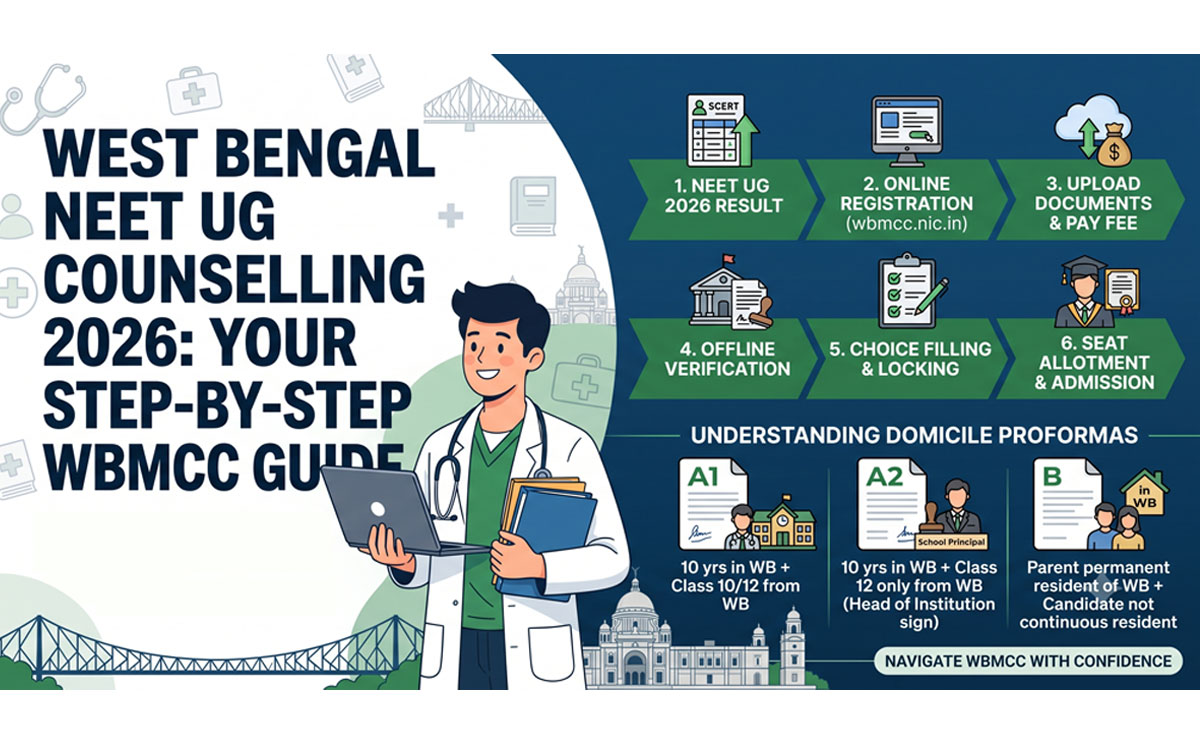
Since WBMCC runs its own distinct counselling structure, it’s worth a separate mention. In West Bengal, NRI Quota seats exist exclusively in private medical colleges — there is no NRI quota in government medical colleges in the state. Private MBBS seats in West Bengal generally follow an 85:10:5 split — 85% state quota (WB domicile only), 10% management quota, and 5% NRI quota.
A few WBMCC-specific procedural points worth knowing:
- NRI quota candidates must meet the same minimum NEET UG 2026 qualifying percentile as Management Quota candidates
- A candidate opting for NRI Quota cannot simultaneously apply under State Quota or Management Quota in the same cycle
- Unlike State Quota applicants, NRI quota candidates in West Bengal are not required to undergo pre-choice-fill physical document verification — they can proceed directly to choice filling after registration and fee payment
Eligible candidates for WBMCC’s NRI quota include NRI, PIO, and OCI applicants, consistent with the national framework.
Top Medical Colleges Offering NRI Quota Seats
A handful of names come up repeatedly when families discuss NRI quota admissions, largely because of their NMC recognition, hospital infrastructure, and international student familiarity:
- Kasturba Medical College, Manipal — flagship MAHE institution, roughly 250 MBBS seats with a portion reserved for NRI candidates
- Kasturba Medical College, Mangalore — sister campus under the same university, similar seat structure
- Sri Ramachandra Medical College, Chennai — established NRI intake, comparatively moderate fee positioning
- JSS Medical College, Mysuru — mid-tier deemed university with a well-established NRI pathway
- D.Y. Patil Medical College, Pune — large hospital infrastructure, higher fee bracket
- Amrita School of Medicine, Kochi/Faridabad — deemed university with NRI seats across two campuses
- SRM Medical College down in Chennai. It is a highly respected deemed university with a solid track record
There is also a hidden trend here you should definitely know about. During the final Stray Vacancy rounds, colleges sometimes have leftover NRI seats. They frequently flip these empty spots into regular Management Quota seats. This sudden shift can massively lower the required admission cutoff. Honestly, it is never a sure thing. The exact availability shifts wildly from year to year. However, it remains a fantastic strategy to watch closely. It is especially useful if your NEET score is hovering slightly below the typical cutoff line.
Have questions about NRI Sponsor relationship proof or Embassy certificates? Request an immediate NRI Document Scrutiny Review before your conversion window opens.
Figures on fees and seat availability are indicative and based on recent counselling cycles. Candidates should verify current-year figures against the official MCC (mcc.nic.in) and respective state counselling authority notifications before making admission decisions.
Disclaimer
The information provided in this guide is for educational and informational purposes only. Medical admission rules, NRI eligibility frameworks, document verification windows, and fee structures are subject to frequent changes by the National Medical Commission (NMC), the Medical Counselling Committee (MCC), and state regulatory authorities. Legal definitions of OCI/PIO/NRI statuses and acceptable sponsor relationships are governed by Supreme Court directives and can be strictly interpreted by nodal centers. Always verify current-year deadlines, fee notifications, and exact document formats directly through the official MCC portal (mcc.nic.in) or your respective state counselling authority before making any financial commitments or submitting paperwork.
Frequently Asked Questions (FAQs)
Yes, no exceptions. There is no direct-admission route into MBBS in India, NRI quota included. Every candidate, whatever their nationality or category, has to qualify NEET UG.
No. Per Supreme Court guidelines, sponsorship has to come from a close blood relation—parents, siblings, grandparents, or uncles/aunts. Sponsorship from friends or non-blood acquaintances gets rejected during document scrutiny.
Yes. Per Supreme Court clarification, OCI and PIO cardholders remain fully eligible for NRI quota seats in deemed universities and private medical institutions.
During counselling, not at NEET registration. Every candidate registers as General by default with NTA, then applies for NRI conversion through a dedicated MCC email window that opens before Round 1 or Round 2.
If your conversion is rejected, your category reverts to General, but you do not automatically lose your security deposit. You can still compete for general or management seats in deemed universities, provided you meet the applicable cutoffs. You only forfeit your deposit if you break standard MCC exit rules (like abandoning an allotted seat in Round 2).
Not all, but many do. Certain deemed universities and specific state colleges (like those in Rajasthan) require a bank guarantee equivalent to the remaining years’ tuition fees to be submitted at the time of admission. You must confirm this with the individual college before locking your choices.
In MCC counselling, once your category is successfully converted to NRI, you are treated as an NRI candidate. However, as an NRI candidate, you are usually eligible to fill choices for both NRI seats and general Management Quota seats in deemed universities. State-level rules differ; for instance, West Bengal forces you to choose one specific quota to compete in.
Have questions about NRI sponsor relationship proof or embassy certificates? Request an immediate NRI Document Scrutiny Review before your conversion window opens.
References & Further Reading
- Official Medical Counselling Committee: MCC UG Counselling Portal
- National Medical Commission: NMC Official Guidelines
- Ministry of External Affairs (India): OCI Cardholder Information and Guidelines
- Legal Precedent Context: Supreme Court Judgment – P. (C) No. 689/2017 (Consortium of Deemed Universities in Karnataka vs Union of India)