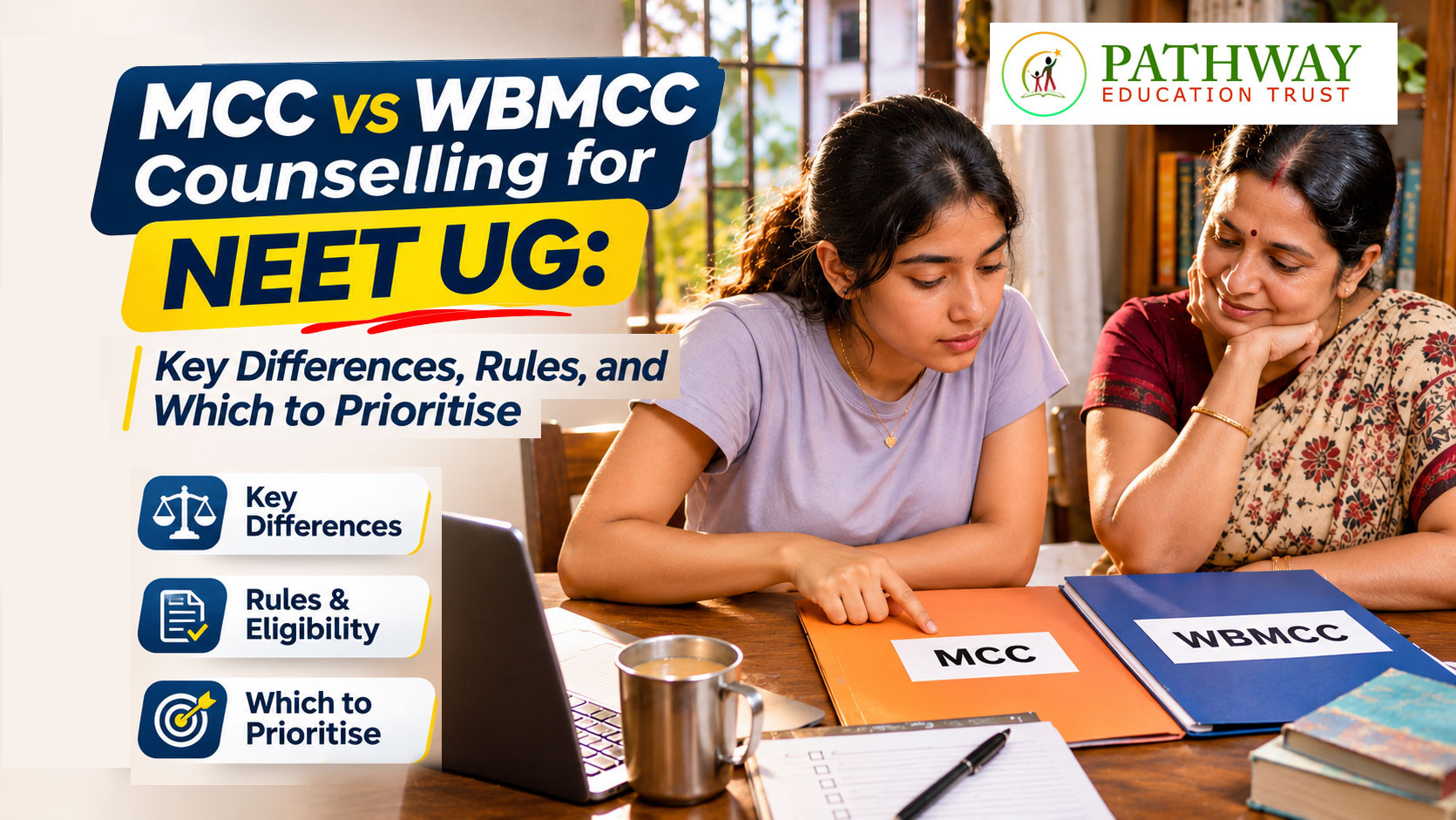
The release of NEET UG scores forces West Bengal candidates into a very difficult corner. Every single year, the exact same question arises.
Should I participate in MCC counselling, WBMCC counselling, or both?
The overlapping timelines cause immense confusion. These two separate processes run side-by-side. They both require tedious registration phases. They both distribute valuable medical seats. Yet, securing a seat in one round can instantly block a candidate from the next. This creates a massive strategic challenge regarding government colleges. Medical hopefuls must choose between fighting for the 15% All India Quota (AIQ) or banking entirely on the 85% West Bengal State Quota. A stellar rank provides endless national opportunities. It also easily secures the best local government colleges. Conversely, a borderline rank might miss the All India cut entirely. However, that exact same score could easily win a seat through local state domicile benefits. Deciding which path to prioritize is not a simple guessing game. It requires a hard look at the actual numbers. The student’s rank, category, and willingness to relocate out of state map out the entire journey. Understanding how MCC vs WBMCC counselling 2026 actually functions is an absolute necessity before making any official moves.
The Quick Answer: MCC and WBMCC Are Different Counselling Authorities
The Medical Counselling Committee, commonly known as MCC, conducts counselling for eligible seats under the All India Quota and several other categories of medical institutions.
WBMCC, or the West Bengal Medical Counselling Committee, conducts state-level counselling for eligible medical and dental seats in West Bengal.
In simple terms, the two systems broadly cover different pools of seats.
MCC counselling generally covers
- 15% All India Quota seats in government medical and dental colleges
- 100% seats in certain central institutions and participating medical colleges
- Deemed university seats
- Other seats that fall under MCC’s counselling jurisdiction, depending on the applicable rules for that year
WBMCC counselling generally covers
- 85% state quota seats in eligible government medical and dental colleges in West Bengal
- Seats in private medical and dental colleges participating in West Bengal state counselling
- Other state counselling categories and eligible seats as notified by the West Bengal authorities
The most important thing to remember is that the same government medical college can have seats under both systems.
For example, a government medical college in West Bengal may have a portion of its seats available through the 15% All India Quota while the larger state quota portion is filled through WBMCC.
This is why the same student can sometimes look at the same college through two completely different counselling routes.
What Is the Difference Between the 15% AIQ and the 85% West Bengal State Quota?
This is usually where the confusion begins.
Under the traditional government medical college seat distribution system, a portion of seats is available under the All India Quota, while the larger state quota portion is reserved for eligible candidates under the relevant state counselling rules.
The practical difference is about who you are competing against.
Under the 15% All India Quota
You compete with eligible NEET-qualified candidates from across India.
Your West Bengal domicile usually does not give you an advantage for the AIQ seat itself.
If you secure an AIQ seat in a government medical college in West Bengal, candidates from other states may also have been competing for that same pool of seats.
Under the 85% West Bengal State Quota
Eligibility is linked to the rules announced by the West Bengal counselling authority.
Students eligible under the state’s domicile and qualification requirements compete within the applicable West Bengal state counselling pool.
This can completely change your chances.
Imagine two students with the same NEET score.
One student has a rank that is not strong enough to comfortably compete for a popular government medical college through the All India Quota. But because that student is eligible for the West Bengal state quota, the competition and closing rank situation may work differently.
The same college.
The same MBBS course.
A completely different route into it.
That is why comparing only college names without understanding the quota can lead students to make poor counselling decisions.
Can You Participate in Both MCC and WBMCC Counselling?
In many cases, eligible students can participate in both counselling processes because MCC and WBMCC handle different seat pools.
This is particularly useful for West Bengal domicile candidates who want to keep their options open.
For example, a student may:
- Register for MCC counselling to explore 15% AIQ opportunities
- Register separately for WBMCC counselling to compete for eligible state quota seats
- Fill choices in both systems based on realistic rank expectations
- Compare the seats allotted through each counselling process before making decisions permitted under the applicable round rules
However, participating in both does not mean that you can casually hold multiple seats indefinitely.
This is where students need to slow down.
Counselling rules regarding seat acceptance, joining, resignation, upgradation, security deposit forfeiture, and eligibility for subsequent rounds can change depending on the counselling round and the official rules issued for that year.
The 2026 counselling schedules and rules should therefore be checked carefully once the official MCC and WBMCC information bulletins are released.
Do not rely on a YouTube video uploaded three years ago by someone explaining rules from an older counselling cycle.
Medical counselling regulations can change.
And old advice can become expensive.
Registration: You Have to Register Separately
One of the most common student queries is whether MCC registration automatically makes them eligible for WBMCC counselling.
It does not.
MCC and WBMCC operate separate counselling systems.
If you want to participate in both, you generally need to complete the separate registration requirements for each counselling authority.
That may include separate:
- Online registrations
- Application details
- Registration fees
- Security deposits where applicable
- Choice filling
- Document verification requirements
- Counselling deadlines
Missing one deadline can close an entire opportunity.
Picture this situation.
A student spends three days carefully researching MCC college choices, comparing closing ranks, watching counselling prediction videos, and arguing with cousins about whether Rajasthan is too far from Kolkata.
Then they forget to register for WBMCC before the deadline.
The student may have had a stronger chance of securing a preferred college through the West Bengal state quota.
That opportunity disappears because of a missed registration date.
Not because of NEET rank.
Because of a calendar.
This is why counselling should be treated like a process, not a single form.
Which Counselling Should You Prioritize?
There is no universal answer.
Your priority should depend on what you actually want.
Prioritize MCC AIQ more seriously if:
- You have a strong All India Rank
- You are open to studying outside West Bengal
- Your preferred medical colleges are located in different states
- You want to explore central institutions or other colleges covered under MCC
- Your AIQ rank gives you realistic access to colleges that may not be available through your state quota
A high-ranking student from West Bengal should not automatically restrict themselves to West Bengal simply because they have domicile eligibility.
If your rank gives you access to a college you genuinely prefer in another state, MCC can open that door.
Prioritize WBMCC State Quota more seriously if:
- You are eligible under West Bengal’s applicable domicile and state counselling rules
- You strongly prefer studying in West Bengal
- Your AIQ rank is less competitive than your position under the state quota
- You want to remain closer to family
- Your preferred government medical colleges are located in West Bengal
There is nothing wrong with prioritizing your home state.
MBBS is a long course.
You are not choosing a weekend workshop.
Location, language, support systems, travel costs, and personal comfort can matter for five and a half years.
The Biggest Mistake: Treating Both Counselling Processes Like Independent Games
This is where students can get into trouble.
MCC and WBMCC may be separate counselling authorities, but your decisions across the two processes still need to be managed carefully.
Suppose a student receives a seat through one counselling process while continuing to participate in another round elsewhere.
What happens next depends on the specific round, joining status, resignation rules, eligibility conditions, and official regulations applicable at that time.
This is where students often make assumptions.
“Someone on Telegram said I can leave after Round 2.”
“My senior did this last year.”
“A coaching video said the security deposit always comes back.”
Dangerous thinking.
Before accepting or leaving a seat, check the current official rules for:
- Seat acceptance
- Reporting and joining deadlines
- Free exit provisions
- Resignation procedures
- Security deposit refund or forfeiture
- Eligibility for subsequent rounds
- Restrictions after joining
- Rules related to upgradation
A seat decision should never be based purely on rank predictions.
Read the rule that applies to that exact round.
How Choice Filling Should Actually Work
Students often approach choice filling emotionally.
They place one dream college first.
Then five random colleges.
Then panic.
A better approach is to divide your choices into practical groups.
Start with your genuine preferences
Add colleges that you would genuinely choose if your rank allows.
Do not avoid a preferred college simply because you think the cutoff might be high. Counselling choice filling is not the same as predicting your final result.
Add realistic options
Look at previous closing trends, but remember that past cutoffs are reference points, not guarantees.
Changes in seat matrix, candidate behaviour, category dynamics, and counselling rules can affect the final result.
Add safe options that you would actually join
This part is important.
Do not fill a college simply because it is available if you know you would never join it.
A seat allotment can create serious decisions depending on the rules of the counselling round.
Your choice list should represent real preferences.
Not panic.
A Simple Example for a West Bengal Student
Imagine a student named Arjun from Kolkata.
Arjun has a competitive NEET rank and wants an MBBS seat.
His first preference is a highly ranked government medical college in West Bengal. He is also open to studying in another state if the college is significantly better than his local options.
Arjun can build two separate strategies.
For MCC counselling, he may place his preferred AIQ colleges according to his genuine national preferences.
For WBMCC counselling, he may arrange eligible West Bengal colleges according to where he would actually want to study.
Now suppose Arjun receives an allotment in one process but is waiting for another result.
This is the moment where guessing becomes risky.
Before joining, resigning, or moving forward, Arjun needs to check the current rules governing that counselling round.
One poorly understood exit rule can matter more than twenty hours spent studying previous-year cutoffs.
That is the messy reality of medical counselling.
MCC vs WBMCC Counselling 2026: What Students Should Keep Track Of
If you are participating in both processes, keep a separate checklist for each.
Track:
- Registration opening and closing dates
- Registration fee requirements
- Security deposit conditions
- Choice filling deadlines
- Choice locking deadlines
- Seat allotment results
- Reporting deadlines
- Document requirements
- Free exit or resignation rules
- Upgradation eligibility
- Stray vacancy rules
- Security deposit refund or forfeiture conditions
Do not keep all of this in your head.
Use a spreadsheet.
A notebook works too.
Anything is better than discovering a missed deadline while sitting at a photocopy shop with eight documents in your hand and absolutely no idea which portal closed at midnight.
The Final Decision: Build Two Strategies, Not One
The smartest approach for an eligible West Bengal student is often to think about MCC and WBMCC as two separate opportunities with two separate rulebooks.
MCC can give you access to the national pool.
WBMCC can give you access to the West Bengal state counselling pool.
Your job is not simply to register everywhere and hope for the best.
Your job is to understand your rank, know where you are willing to study, build sensible preference lists, and pay close attention to what happens after a seat is allotted.
Because in NEET counselling, getting a seat is only one part of the process.
Knowing what to do with it is the other.
Participating in Both MCC and WBMCC Counselling?
Choice filling across two counselling systems can become confusing quickly, especially when allotment schedules, reporting dates, upgradation rules, and seat exit conditions overlap.
Participating in both MCC and WBMCC? Let our counsellors help you manage your choice filling and understand the applicable counselling rules before a seat decision leads to cancellation or unnecessary loss of a security deposit.
Disclaimer
Counselling Rules & Seat Allotment Notice: This guide is intended for informational and strategic planning purposes only and reflects the Medical Counselling Committee (MCC) and West Bengal Medical Counselling Committee (WBMCC) structures as of the 2026 NEET UG admission cycle. Counselling schedules, security deposit forfeiture rules, free-exit provisions, and eligibility criteria are subject to change by the respective authorities at any time. Candidates must strictly refer to the official 2026 Information Bulletins published on the MCC and WBMCC websites before making any binding decisions regarding seat acceptance, upgradation, or resignation.
Frequently Asked Questions
Eligible candidates may be able to participate in both because MCC and WBMCC manage different counselling processes and seat pools. You must complete the applicable registration and eligibility requirements separately and follow the official rules for both authorities.
No. West Bengal students can participate in MCC counselling if they meet the eligibility requirements. The 15% All India Quota allows eligible candidates to compete for participating seats across India, including AIQ seats in West Bengal government medical colleges.
WBMCC handles eligible state counselling seats in West Bengal according to the applicable seat matrix and counselling rules. Students should check the official 2026 information bulletin for the exact distribution and eligibility requirements.
Neither is automatically better. MCC may offer stronger national opportunities for students with competitive All India Ranks and flexibility about location. WBMCC can be extremely important for eligible students seeking medical colleges in West Bengal under the state counselling system.
Security deposit forfeiture can depend on the counselling authority, round, allotment status, joining decisions, resignation rules, and other conditions specified in the official counselling guidelines. Always read the current 2026 rules before making a seat exit decision.
No. While you can participate in both counselling processes simultaneously, strictly enforced rules prevent seat blocking. If you join an allotted seat in MCC Round 2 or Round 3, your admission data is shared with state authorities, making you ineligible to participate in further WBMCC state counselling rounds. You must decide which seat to formally join based on the specific resignation deadlines of that round.
Under 2026 MCC rules, Round 1 offers a “Free Exit,” meaning you can walk away from an allotted seat without financial penalty. However, if you are allotted a seat in MCC Round 2 and choose not to join it (because you prefer your WBMCC state quota seat), you will permanently forfeit your MCC security deposit (₹10,000 for government seats, or up to ₹2,00,000 for deemed universities).
No. When applying for the 15% All India Quota through MCC, you are competing on a national level, and state domicile requirements do not apply. You only need the official West Bengal Domicile Certificate (Proforma A1, a2, or b) when registering for the 85% State Quota counselling conducted independently by WBMCC.
No. MCC and WBMCC operate as completely independent authorities. You must complete separate online registrations, pay separate non-refundable counseling fees, and submit separate refundable security deposits on their respective portals before their individual deadlines close.