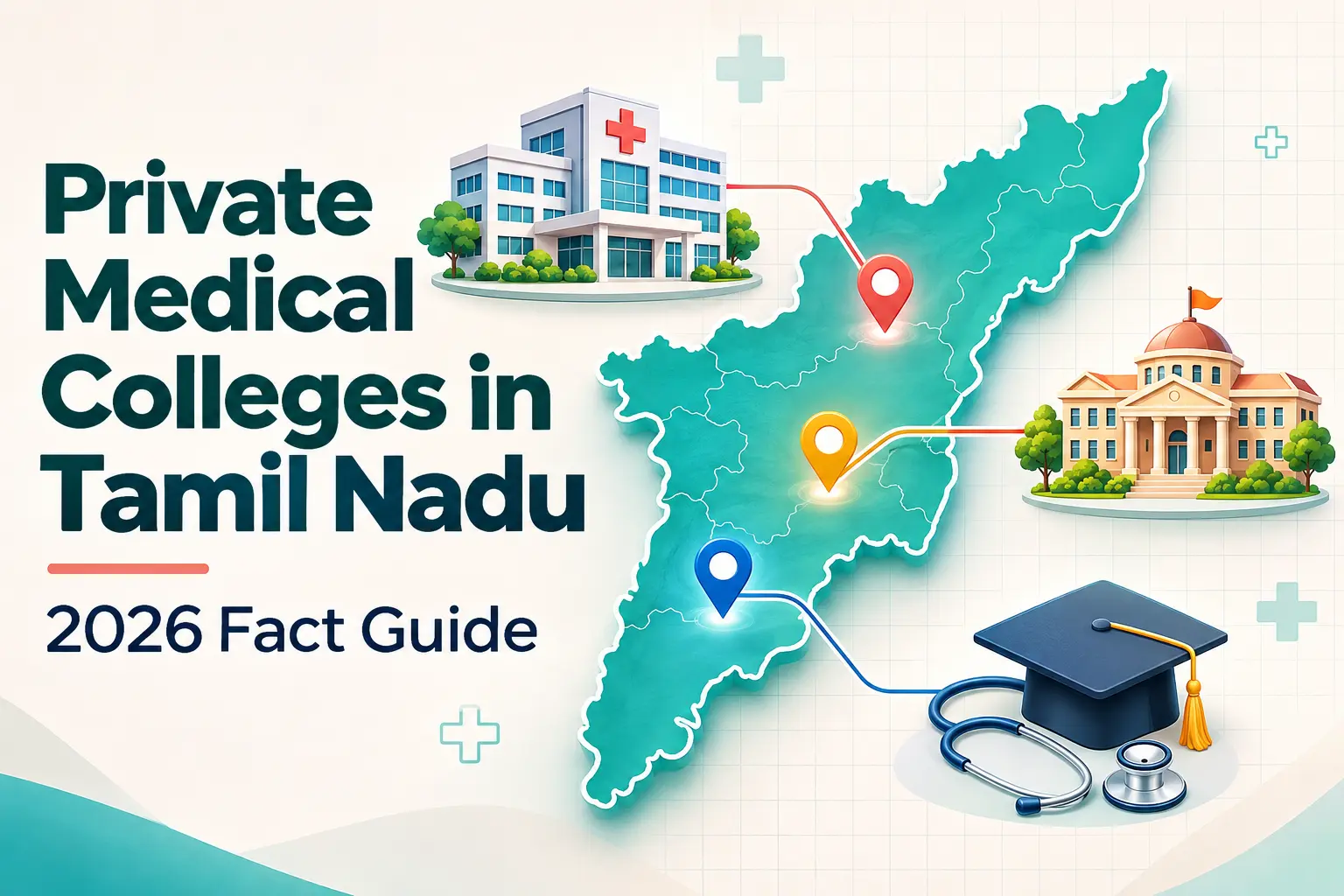
Typing this question into a search bar is a common and confusing step for many families, as the answers pile up quickly. The numbers shown are twelve, twenty-four, twenty-six, twenty-eight, forty, and one hundred and eighty-three, all for the same state and the same year. That mess is exactly why so many NEET aspirants and parents end up more confused after researching than before. The truth is simpler than the search results suggest, but only if it is known what each number is actually counting. This guide breaks down how many private medical colleges in Tamil Nadu are counted in 2026-27, why the figure changes from site to site, and what it means for an admission plan.
Where Things Stand as of Late November 2026-27
The short answer is a useful and honest starting point for aspirants. There is no single official “private medical colleges” number, as it depends on how the institution is classified. Here is the working picture. The National Medical Commission lists roughly 78 medical colleges in Tamil Nadu, and around 37 to 39 of those are government (including one ESIC college). That leaves about 40 on the private side, once deemed universities are counted, and Moksh16’s 2026-27 listing, for instance, puts it at 38 government and 40 private.
Now the figure can be narrowed down. For the state counselling run by Tamil Nadu’s Selection Committee in 2026-27, the tentative seat matrix covered 59 colleges. Of those, 19 were self-financing institutions, and 3 were private university colleges, so around 22 private-side colleges sit inside state counselling. The rest of the private count is made up of deemed universities, which run on a separate track.
One more timing note is needed here. The 2026-27 cycle is largely done, as stray-round vacancy trackers showed 114 MBBS seats open in self-financing colleges and 196 in private colleges as of 17 October 2026-27, and those numbers shrank to a handful by early November. For readers planning for 2026-27, the 2026-27 figures should be treated as a baseline, not a promise.
Why the Number Changes Depending on Who You Ask
Tamil Nadu’s private medical sector is a layered and diverse system, as it isn’t one block. It is three different types of institutions, each with its own rules.
- Self-financing medical colleges: Privately run, affiliated with the state health university, and filled through Tamil Nadu’s state counselling. The 2026-27 tentative matrix counted 19 here, while another tracker of the vacancy list counted 20.
- Private university colleges: Colleges run under private universities, such as Sri Venkateswaraa Medical College Hospital (Chennai), Kanyakumari Medical Mission Research Center, and Takshashila Medical College (Tindivanam). These also take part in state counselling. The 2026-27 matrix counted 3.
- Deemed universities: Institutions with deemed status, whose MBBS seats are filled through MCC counselling, not the state. Sources count somewhere between 12 and 16 of them.
Now the source of the confusing numbers is easy to see. A site counting only self-financing colleges says 19 or 20, a site counting state counselling participants says about 22 or 23, and a site adding deemed universities lands near 40. And Collegedunia’s 183? That figure counts private medical colleges across all courses, including physiotherapy and BSc programmes, so it isn’t an MBBS count at all. When a number looks wrong, what it is measuring should be checked.
Understanding the Categories at a Glance
The categories are a clear and organised way to read the numbers, and they are compared below.
| Category | Approx. Colleges (2026-27) | Counselling Body | Who Can Apply |
| Self-financing medical colleges | 19–20 | Tamil Nadu Selection Committee | Government Quota for Tamil Nadu residents; Management and NRI Quota open to other states |
| Private university colleges | 3 | Tamil Nadu Selection Committee | Same quota structure as above |
| Deemed universities | Roughly 12–16 (varies by source) | MCC | Students from any state |
A few points on how quotas work inside these colleges are useful. Seats in self-financing colleges are split between Government Quota, Management Quota, and NRI Quota, and some colleges also reserve Minority Quota seats, including Christian, Malayalam, and Telugu minority categories. Deemed universities don’t follow the state’s split at all, as their seats are filled through MCC, and any NEET-qualified candidate can apply.
Eligibility Basics
Eligibility is a strict and important matter for every candidate, and the core requirement is the same across all three categories.
- A candidate must qualify NEET UG for the relevant year
- The minimum percentile and academic criteria set by NTA and NMC for the category must be met
- Government Quota seats in state counselling are meant for Tamil Nadu residents
- Management and NRI Quota seats are open to candidates from other states
One thing is worth confirming early, as the exact eligibility rules, cutoff dates, and category conditions come from the official information bulletin each year. A coaching site’s summary should not be relied on when the stakes include a seat worth several lakhs.
How Admission to Private Colleges Works
The admission process is a stepwise and time-bound journey for aspirants. The details are confirmed in each year’s official notification, but the pattern has held steady across recent cycles.
- Qualify NEET UG and keep the scorecard ready
- For self-financing and private university colleges, register on the Tamil Nadu Selection Committee portal (tnmedicalselection.net)
- For deemed universities, register separately through MCC (mcc.nic.in)
- Complete choice filling after the merit list and seat matrix are released
- Accept the allotment, pay the required fees, and report to the college within the deadline
- If seats remain, watch for stray-round vacancy lists
There are two registrations, two portals, and two sets of deadlines, and missing the second one is more common than expected.
Fees: Why There’s No Single Number
Fees at private medical colleges in Tamil Nadu are a variable and widely debated topic, as they are regulated by state fee committees and vary widely. A Government Quota seat in a self-financing college costs far less than a Management Quota seat in the same building, and deemed universities set their own fee structures. Online figures contradict each other badly, with annual ranges quoted anywhere from single-digit lakhs to well above ₹20 lakh depending on the source. So a blog’s average should not be used for planning, and the fee schedule published for the specific college and quota in the official notification should be checked.
Seat Matrix: What’s Known So Far
The seat matrix is a detailed and reliable guide for planning, and the tentative 2026-27 state matrix showed the figures below for the private side.
| College Type | Number of Colleges | Approx. MBBS Seats |
| Self-financing medical colleges | 19 | 3,350 |
| Private university colleges | 3 | 575 |
That is roughly 4,000 MBBS seats on the state counselling private side. For comparison, the same matrix showed about 4,000 seats in government colleges, putting total state counselling seats near 8,000. Zooming out changes the picture, as NMC data puts Tamil Nadu’s total MBBS capacity between roughly 13,000 and 14,000 seats, depending on the date of the data. That gap is mostly deemed university seats, which sit outside the state pool.
A few notable names from the sector are Christian Medical College, Vellore (established 1942, the oldest private institution), PSG Institute of Medical Sciences in Coimbatore, SRM Medical College in Trichy, and Panimalar Medical College in Chennai. The newest addition on record is APS Medical College Hospital and Research Institute, established in 2026. Seat numbers shift every year as NMC approves new intake or revises capacity, so final numbers come from the official seat matrix, not from this guide.
Not sure which Tamil Nadu private medical college fits your NEET score and budget? Speak to our admission team for personalised guidance before the next counselling window opens.
Disclaimer
Medical Admissions & Regulatory Notice: The college counts, seat matrices, and counselling structures outlined in this article are based on the 2026–27 NEET UG admission cycle and are intended strictly for informational purposes. MBBS seat intake, annual permissions, and institutional recognition are governed by the National Medical Commission (NMC) and its Medical Assessment and Rating Board (MARB), and may change from one academic year to the next. Tuition fees for self-financing colleges in Tamil Nadu are regulated by the state’s fee fixation committee and vary sharply by quota, while deemed universities determine their own fee structures. Aspirants and parents must verify final college approvals, eligibility rules, fee schedules, and counselling deadlines directly on the official NMC, Tamil Nadu Selection Committee, and Medical Counselling Committee (MCC) portals before submitting applications or paying fees.
Frequently Asked Questions
About 22 take part in state counselling (19 self-financing plus 3 private university colleges). Including deemed universities, the private side totals roughly 35 to 40, depending on the source and how deemed institutions are counted.
They count different things. Some count only self-financing colleges. Others add deemed universities. A few count private medical colleges across all courses, which inflates the total into the hundreds.
No. Their MBBS seats are filled through MCC, and candidates from any state can apply.
Yes. Management Quota and NRI Quota seats are open to non-residents. Government Quota seats in state counselling are for Tamil Nadu residents.
Mostly. Stray-round vacancies were being cleared in October and early November 2026. Candidates planning for the next cycle should watch for the new information bulletin and seat matrix.
Yes, through two separate routes. Non-Tamil Nadu residents can apply for Management Quota and NRI Quota seats in Tamil Nadu’s self-financing and private university colleges by registering on the Tamil Nadu Selection Committee portal, and they can also apply for all seats in Tamil Nadu’s deemed medical universities through MCC counselling. Only the Government Quota seats inside private colleges are reserved for Tamil Nadu domicile candidates.
Does registering on the MCC portal automatically cover Tamil Nadu's self-financing medical colleges?
No. MCC handles only All India Quota (AIQ) seats in government colleges, central institutions, and deemed universities. To be considered for Tamil Nadu’s self-financing and private university medical colleges, candidates must complete a separate registration and choice-filling process on the Tamil Nadu Selection Committee portal (tnmedicalselection.net).
In Tamil Nadu’s self-financing and private university colleges, tuition is determined by the admission quota rather than just the college name. Students allotted a seat under the Government Quota pay a significantly lower state-regulated fee than students admitted to the same classroom under the Management Quota or NRI Quota.
Do not rely solely on third-party college directories or older recognition certificates. Check the official NMC College and Course Search portal to confirm that the institution is listed, its MBBS intake is approved, and it holds valid admission permission for the active academic session.