
Every counselling cycle brings some new rule that catches half the candidate pool off guard. This year, it’s Freeze and Float.
If you’ve been scrolling through NEET forums and keep seeing those two words thrown around without a clear explanation, you’re not alone. MCC introduced this system for NEET UG 2026, and it genuinely changes how seat upgradation works — for the better, mostly. Here’s what it actually means, how it works round by round, and what you need to do differently this year.
What Changed, in Plain Terms
Until last year, if you got a seat allotted and wanted a shot at something better in the next round, you still had to show up. Physically. At the college. Just to stay “in the running” for an upgrade, even if you had zero intention of joining that particular seat.
That’s gone now.
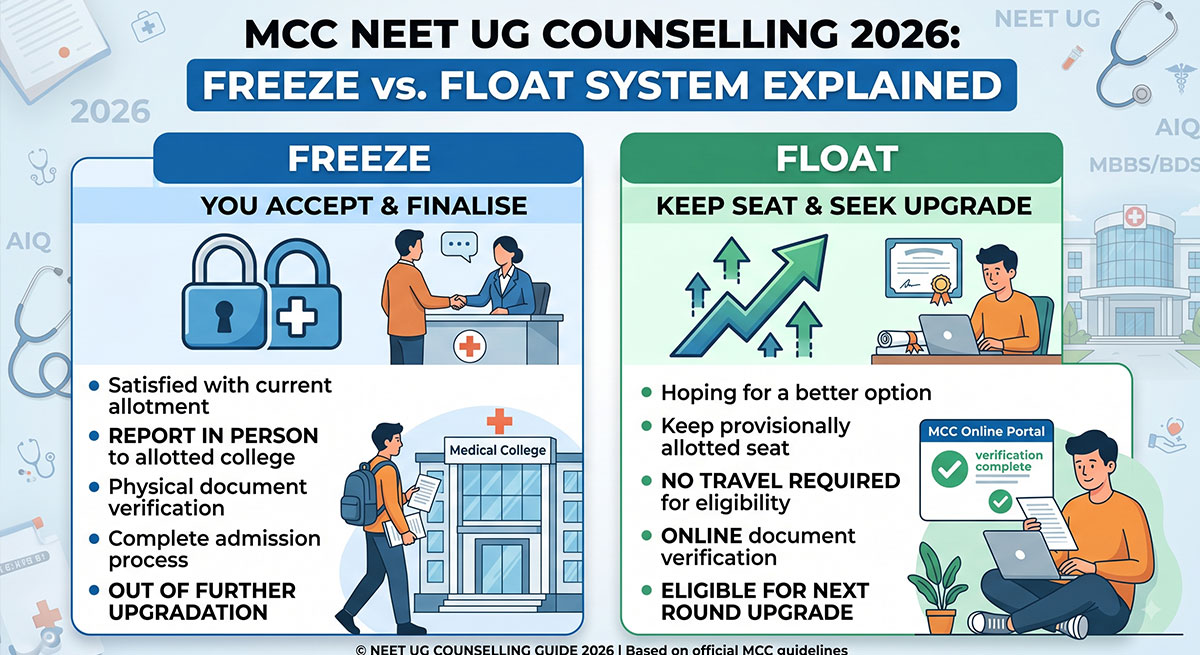
MCC’s 2026 Information Bulletin, released alongside the counselling schedule on 1st August, introduces a clean split: Freeze and Float. After every round’s seat allotment, every candidate has to pick one.
Freeze means you’re satisfied. You accept the seat, report to the college in person, and complete admission there. Done, you’re out of further upgradation.
Float means the opposite. You keep the seat you’ve been allotted, but you’re still in the race for something better next round. And here’s the actual change: you no longer need to travel anywhere to stay eligible. Document verification for Float candidates happens entirely online, through the allotted institute’s Document Verification Committee.
For Float candidates, the seat remains provisionally confirmed until the online document-verification process is completed successfully. A discrepancy, missing document, or unresolved query may lead to cancellation of the allotment.
Simple idea. Big practical difference, especially if you’re allotted a college six states away and were dreading the travel just to “hold” a seat you didn’t even want.
How Float Actually Works, Step by Step
- The seat allotment result is published on the MCC portal
- You log in and choose Float instead of Freeze
- You upload scanned copies of the required documents directly on the portal, no physical visit
- The allotted institute’s Document Verification Committee checks everything online: identity proof, category certificates, academic records, and so on
- Once verification clears, you download your provisional seat allotment letter from the portal
- If a better seat comes up in the next round based on your rank and choices, you get automatically upgraded
- If nothing better comes through, you simply keep the seat you already have
No back-and-forth. No missed trains. No standing in a verification queue at 7 AM while your actual preference is a completely different city.
One thing worth being precise about: this online route is only for candidates who want to stay eligible for an upgrade. If you’re happy with your seat and choosing Freeze, physical reporting is still very much required, and there’s no way around that.
Why This Matters More Than It Sounds
Think about what the old system actually cost people. A candidate from Kerala allotted a seat in Punjab, hoping for something closer to home in Round 2, used to have to travel there anyway, verify documents in person, and then possibly travel right back if the upgrade came through. Multiply that across three rounds, and you’re looking at real money and real stress- money some families genuinely couldn’t spare, and stress nobody needed on top of an already nerve-wracking process.
Float removes that travel tax entirely for candidates chasing an upgrade. It doesn’t remove the uncertainty of counselling, that’s inherent to the system, but it does remove a very specific, very avoidable burden that had nothing to do with merit or eligibility. Just logistics.
Freeze vs Float: Quick Comparison
| Freeze | Float | |
| What it means | You accept and finalise the allotted seat | You keep the seat but stay open to an upgrade |
| Verification | In-person, at the allotted institute | Online, through document upload and DVC review |
| Eligible for next round upgrade | No | Yes |
| Resignation, if needed | In person | Follows the portal workflow and applicable round-specific deadline |
| Best suited for | Candidates satisfied with their current allotment | Candidates hoping for a better rank-based option |
The Round-by-Round Structure
MCC NEET UG 2026 counselling runs across four rounds: Round 1, Round 2, Round 3, and a Stray Vacancy Round. Registration, choice filling, and seat allotment are conducted online throughout, but physical reporting still applies for Freeze candidates in every round, and for all candidates allotted a seat in Round 3. Each round typically spans 15 to 20 days. The four rounds aren’t interchangeable: Round 3 carries stricter joining and resignation consequences than Rounds 1 and 2, and the Stray Vacancy Round follows its own separate set of rules, covered further below.
Round 1 dates, as released in the official schedule:
| Stage | Dates |
| Registration & fee payment | 5–12 August 2026 |
| Choice filling | 6–12 August 2026 |
| Choice locking | Until 13 August 2026 (check portal for exact closing time) |
| Seat allotment result | 17 August 2026 |
| Reporting/verification of joined candidates | 18–22 August 2026 |
A few things worth flagging here, because they trip people up every year. Fresh registration is required for Round 2 and Round 3 if you didn’t register in Round 1, or if you remained unallotted; registering once does not automatically carry you forward. And once choices are locked, they cannot be edited for that round. Anything left unlocked at the deadline gets auto-locked in the order it was arranged, which is exactly why rushing your choice list at the last hour is a genuinely bad idea.
The undergraduate academic session for MBBS, BDS, and B.Sc. Nursing is set to begin on 8th September 2026, so the entire counselling window, upgrades included, is designed to wrap up before that date.
Upgradation Has a Limit — Round 3 Is the Cutoff
Float keeps you eligible for upgrades, but only up to Round 3. Once you accept and join a seat allotted in Round 3, that’s final. No resignation, no further counselling participation, no second-guessing after that point.
This also affects how seats move through the system. Exit or resignation remains possible for seats allotted in Round 1 and Round 2; Freeze candidates do this in person, while Float candidates follow the portal workflow and the applicable round-specific deadline. That option isn’t available once you’ve joined a Round 3 seat. No offline resignations are accepted at any stage, regardless of whether you’re Freeze or Float.
Registration Fees for 2026
Fees depend on the seat category you’re applying for. Figures below are as summarised in published schedules — always cross-check the exact category-wise wording in the official Information Bulletin before paying:
- 15% AIQ, Central Universities, AIIMS, JIPMER, AFMC, ESIC, or B.Sc Nursing seats: ₹1,000 non-refundable registration fee plus a ₹10,000 refundable security deposit for General/EWS candidates, and ₹500 registration plus a ₹5,000 refundable security deposit for SC/ST/OBC/PwD candidates
- Deemed University seats: ₹5,000 non-refundable registration fee plus a ₹2,00,000 refundable security deposit, applicable across all categories
The security deposit comes back if you don’t get allotted a seat, or if you exit within the permitted rules. It gets forfeited if you miss a reporting deadline, fail to join after a later-round allotment, or submit false information. That deposit isn’t a formality; treat the deadlines like they actually cost money, because they do.
What About PwD, NRI, and OCI Candidates?
A few category-specific rules are worth knowing if they apply to you.
PwD candidates need a valid UDID card and the prescribed affidavits. Only candidates who obtain the required eligibility certificate get shown PwD seat choices at all, and that certificate is valid only for the current academic session. MCC has also been direct about the consequences of gaming this: a fake UDID card or affidavit leads to seat cancellation, and possibly legal action.
NRI, OCI, and foreign national candidates follow a separate document verification track. If you’re converting from Indian category to NRI category, you’ll need to submit additional proof — documents establishing the relationship or legal guardianship involved, on top of the standard requirements.
For the Stray Vacancy Round specifically, MCC shares allotment data with individual states. If your name shows up in any state counselling allotment list, or in a central list, you get removed from consideration for the All India Stray Vacancy Round. Worth checking both lists carefully if you’re participating in more than one counselling process simultaneously.
Documents You’ll Need Either Way
Whether you choose Freeze or Float, have these ready before Round 1 registration opens:
- NEET UG 2026 admit card and scorecard
- Class 10 certificate and mark sheet (for date of birth proof)
- Class 12 certificate and mark sheet
- A valid photo ID proof
- Passport-size photographs (typically eight)
- Provisional seat allotment letter, once issued
- Category certificate — SC, ST, OBC, or EWS — if applicable
- PwD certificate and UDID card, if applicable
Both Freeze and Float candidates must upload clear scanned copies of the required documents through the MCC portal within the prescribed reporting window. Freeze candidates must also carry their original documents for physical verification and admission at the allotted institute. Float candidates undergo online verification by the allotted institute’s nodal officer or Document Verification Committee.
Need help navigating MCC choice filling and seat locking? Book a 1-on-1 MBBS Counselling Session with our senior analysts.
This guide reflects the MCC NEET UG 2026 Information Bulletin and counselling schedule as released. Dates, fees, and procedural rules are subject to revision by MCC; the official UG counselling portal, mcc.nic.in, remains the final authority, and candidates should cross-check every deadline and category-wise fee detail there before proceeding.
Formal Disclosure: This article includes an optional free counselling service offered by our team. The service is independent of MCC, and booking a session does not influence seat allotment, verification, or admission decisions.
Disclaimer
This article is intended for general educational and informational purposes only. It is based on the MCC NEET UG 2026 Information Bulletin and counselling updates available at the time of writing. Counselling dates, fees, security deposits, verification procedures, resignation rules, seat availability, and eligibility requirements may change through official notices or court directions. This guide does not guarantee admission, seat allotment, upgrade, refund, or eligibility. Candidates must read the latest bulletin and notices published on the official MCC website at mcc.nic.in before registering, selecting Freeze or Float, uploading documents, resigning from a seat, or reporting to an institute. For individual admission decisions, consult MCC or a qualified counselling professional.
Frequently Asked Questions
Yes. The choice is made fresh after each round’s seat allotment, based on whether you’re satisfied with what you’ve got that round.
The system is built around choosing per round based on your allotment at that stage. If you’re happy with a seat allotted in a later round, you’d choose Freeze at that point rather than continuing to float.
Upgradation through Float is available up to Round 3. Once you join a seat allotted in Round 3, you’re locked in — no further floating, no resignation.
No. Float means you keep your current allotted seat while remaining eligible for something better. If no upgrade comes through, you retain what you already have.
Yes. The allotted institute’s Document Verification Committee reviews uploaded documents with the same scrutiny — identity proof, category certificates, and academic records all get checked. Blurred scans, mismatched certificates, or missing documents can trigger a query, so upload clearly and correctly the first time.